The Journey Towards Becoming an Oscar-Winning Art Director
Embarking on my career path has resembled a meandering journey, with twists and turns leading to unexpected destinations. My pursuit of the dream of becoming an Oscar-winning art director is a testament to this winding path. It’s a journey that has been both slow and deliberate, characterized by self-education and an unwavering commitment to my craft.
In a recent moment of introspection, I took a few hours to define my aspirations clearly. My goal is resolute: to become an Oscar-winning art director. This vision of my future is not merely a daydream but a meticulously planned destination. I envision a future where my approach to designing film environments is methodical and replicable, where my knowledge of historic architectural and costume progression is encyclopedic, and where I have access to talented and trusted crews, vendors, and resources. It’s a future marked by an ever-expanding understanding of what can be tangibly achieved for the lens.
But what is it about art direction that fuels my ambition? For me, it’s the profound impact of masterful storytelling. I believe that films, in particular, have the power to change lives and make people think in ways they never have before. Movies can plant intellectual seeds that transcend culture, literacy, and economic standing. The potential to create such impactful narratives is what drives me.
However, one question looms—what has held me back from pursuing my dream with unwavering determination? The answer, I candidly admit, is fear. The fear that my creative output does not yet reflect my exacting taste has, at times, paralyzed me. For years, I have shied away from showcasing my work, afraid of being judged for art that I felt was not ready for portfolio branding.
But today marks a new beginning. I am determined to shed my inhibitions and get to work. I am initiating several projects to sharpen my design skills, starting with a film review blog. This blog, unlike most others, will focus exclusively on evaluating films based on their scenic merits. I have curated a selection of 92 films officially celebrated for their art direction, with a primary focus on Academy Award winners.
By closely examining these cinematic classics, I hope to gain insights into what makes a film truly Oscar-worthy. Are there compositional, tonal, or thematic trends that are universally applicable? I plan to share my findings, inviting feedback and sparking lively debates on this often-underappreciated aspect of filmmaking.
The journey of becoming an Oscar-winning art director is not just a personal aspiration but an opportunity to inspire others to pursue their dreams with tenacity and an unwavering commitment to their craft. It’s a reminder that the road to success may be meandering, but each step forward brings us closer to our destination.
Unveiling the Creative Journey: Behind the Scenes of “Secret Number”
Creativity knows no boundaries, and every artistic endeavor has a unique story waiting to be told. One such narrative is the journey behind the scenes of “Secret Number,” a captivating short film. While the final product shines on the screen, it’s the creative process that truly brings the story to life.
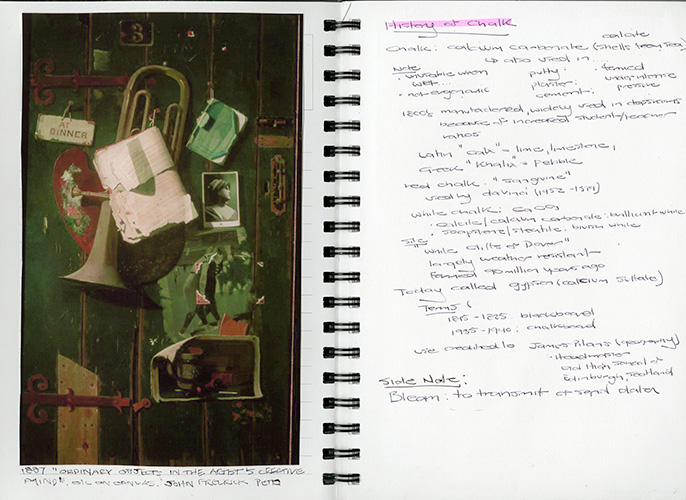
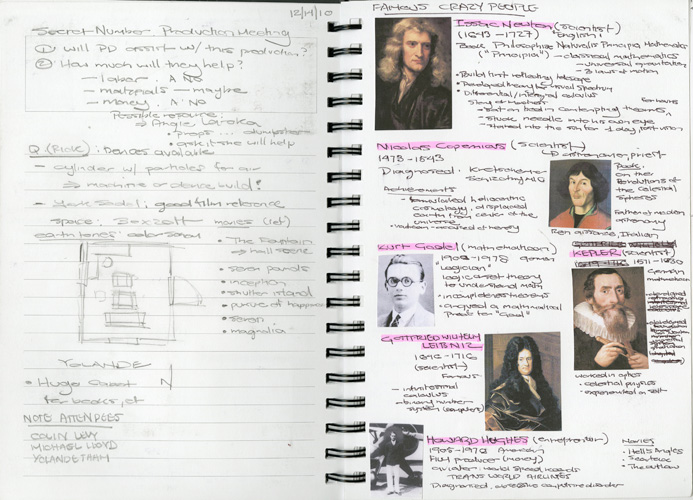
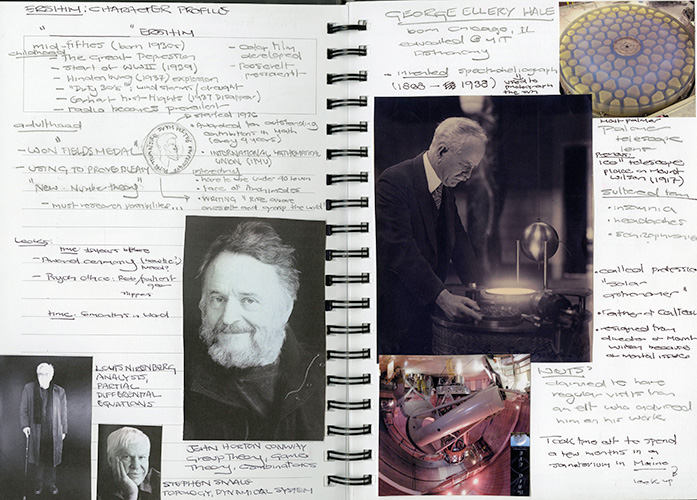
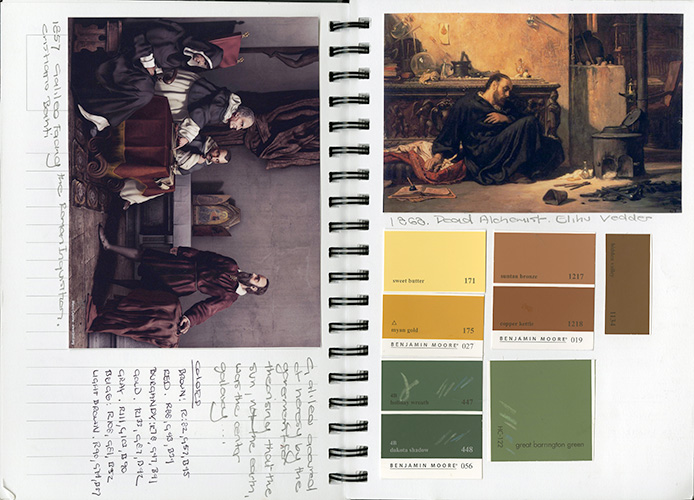
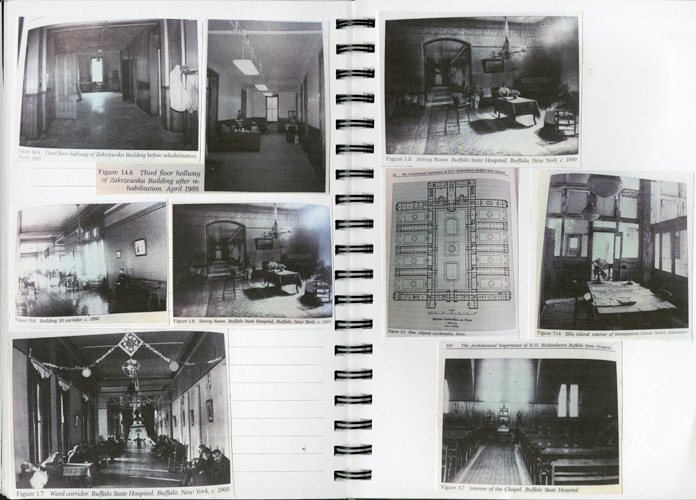
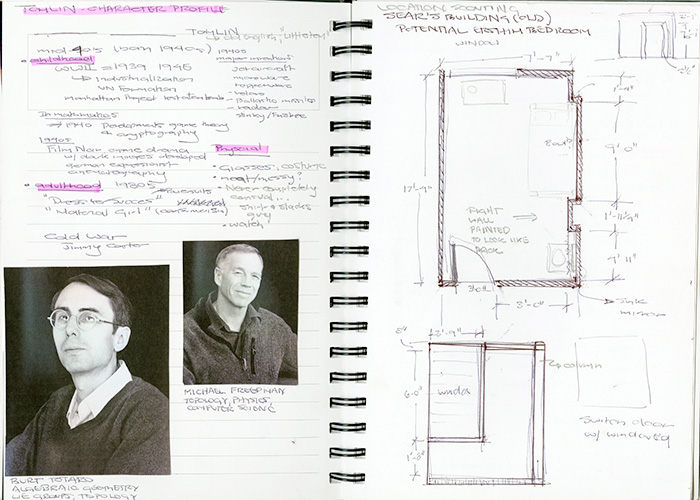
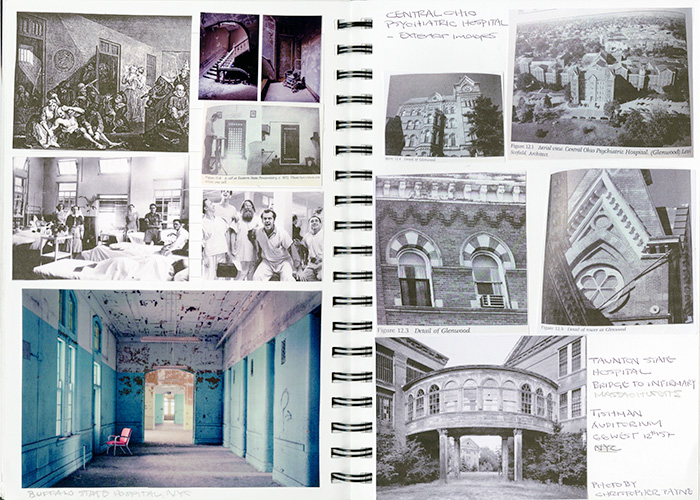
The pages from the process book for “Secret Number” offer a glimpse into the intricate web of inspiration, research, and planning that goes into crafting a cinematic masterpiece. Filled with inspirational paintings, research photos, and thumbnail layouts, these pages are more than just a visual diary—they are a window into the creative mind of the artist.
Planning meetings may have been the backdrop for these pages, but they are far from mundane notes. They are a testament to the artist’s unwavering dedication to capturing the perfect aesthetic, emotion, inspiration, and scope for each film scene. Every stroke of the brush and every image is carefully chosen, and every thumbnail sketch is a step closer to the realization of the filmmaker’s vision.
In the world of filmmaking, all roads of inquiry are not only valid but essential. They lead to discovering new ideas, unexpected emotions, and uncharted horizons. It’s the willingness to explore every avenue, no matter how unconventional, that often leads to groundbreaking cinematic experiences.
The journey of “Secret Number” was not just about creating a film; it was an exploration of creativity and an opportunity to learn and grow. The film crew’s collaboration and the artist’s dedication converged to craft a narrative that transcends the screen.
While the final product is a testament to the power of storytelling, the process book pages are a tribute to the creative journey that brought “Secret Number” to life. They remind us that behind every captivating film lies a world of inspiration, experimentation, and artistic exploration.
The Art of Design Challenges: Turning Sand Castles into Skill Refinement
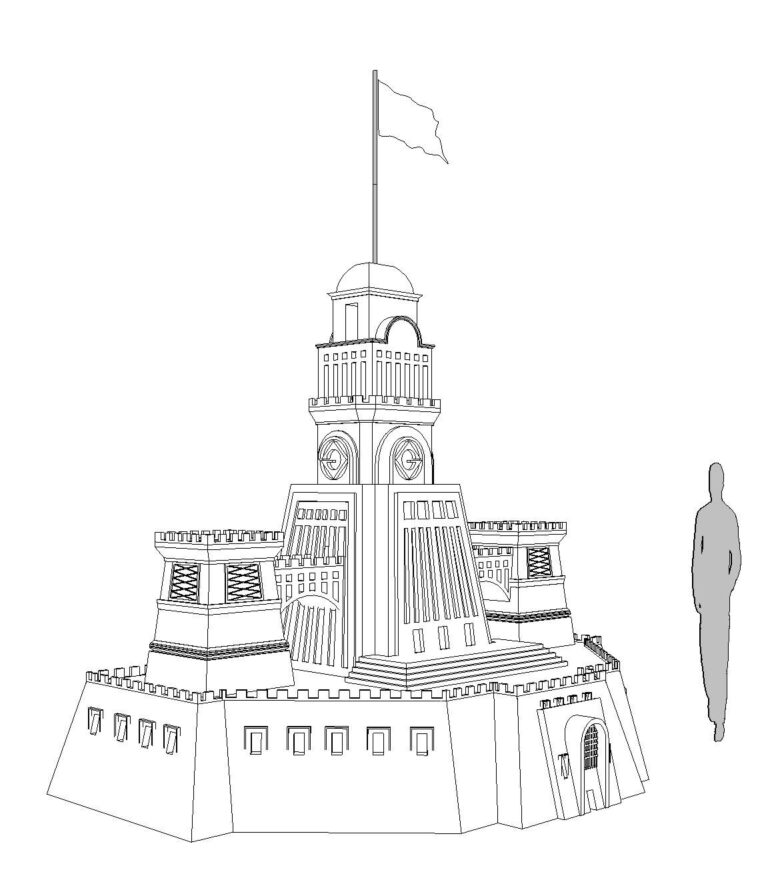
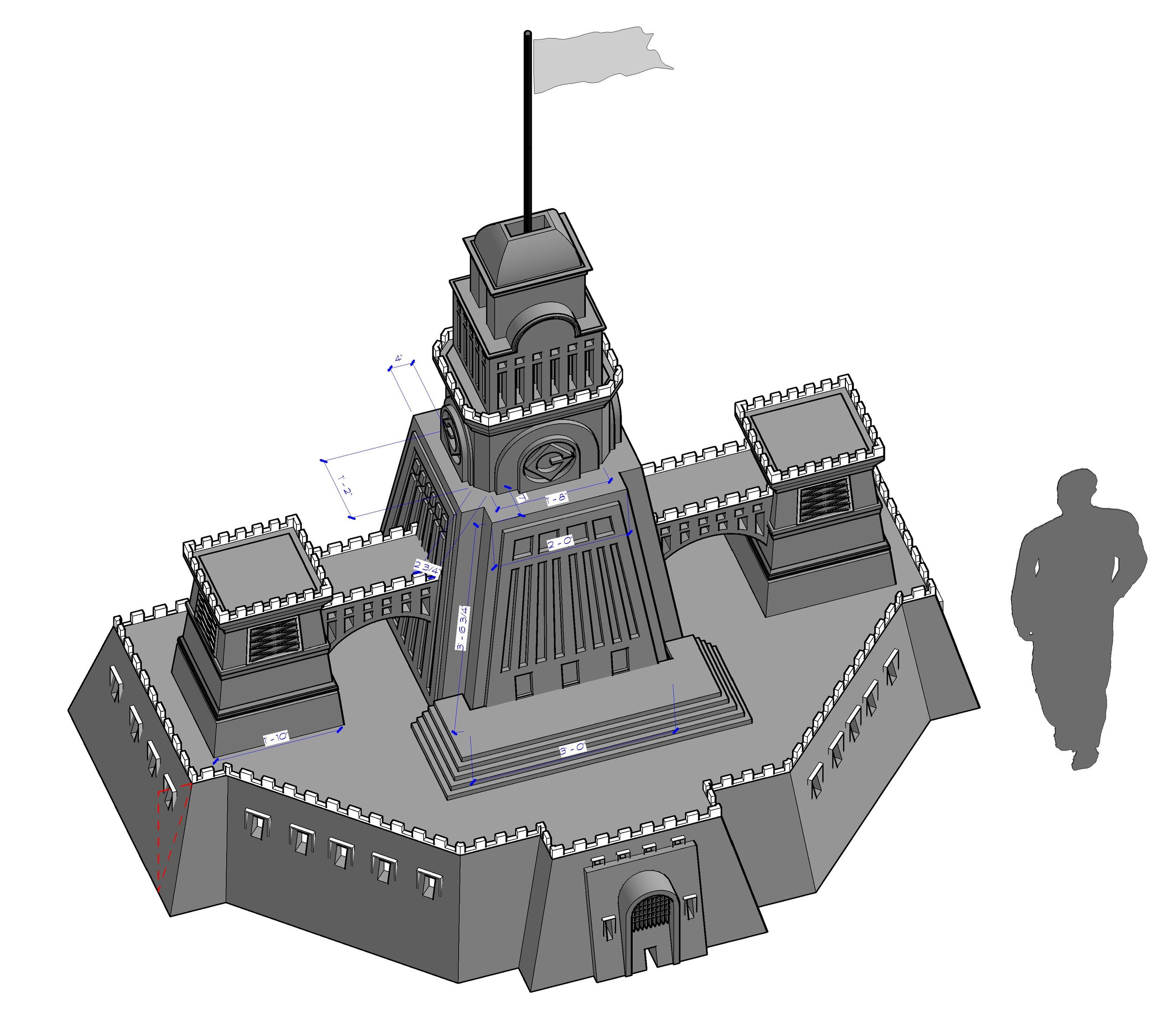
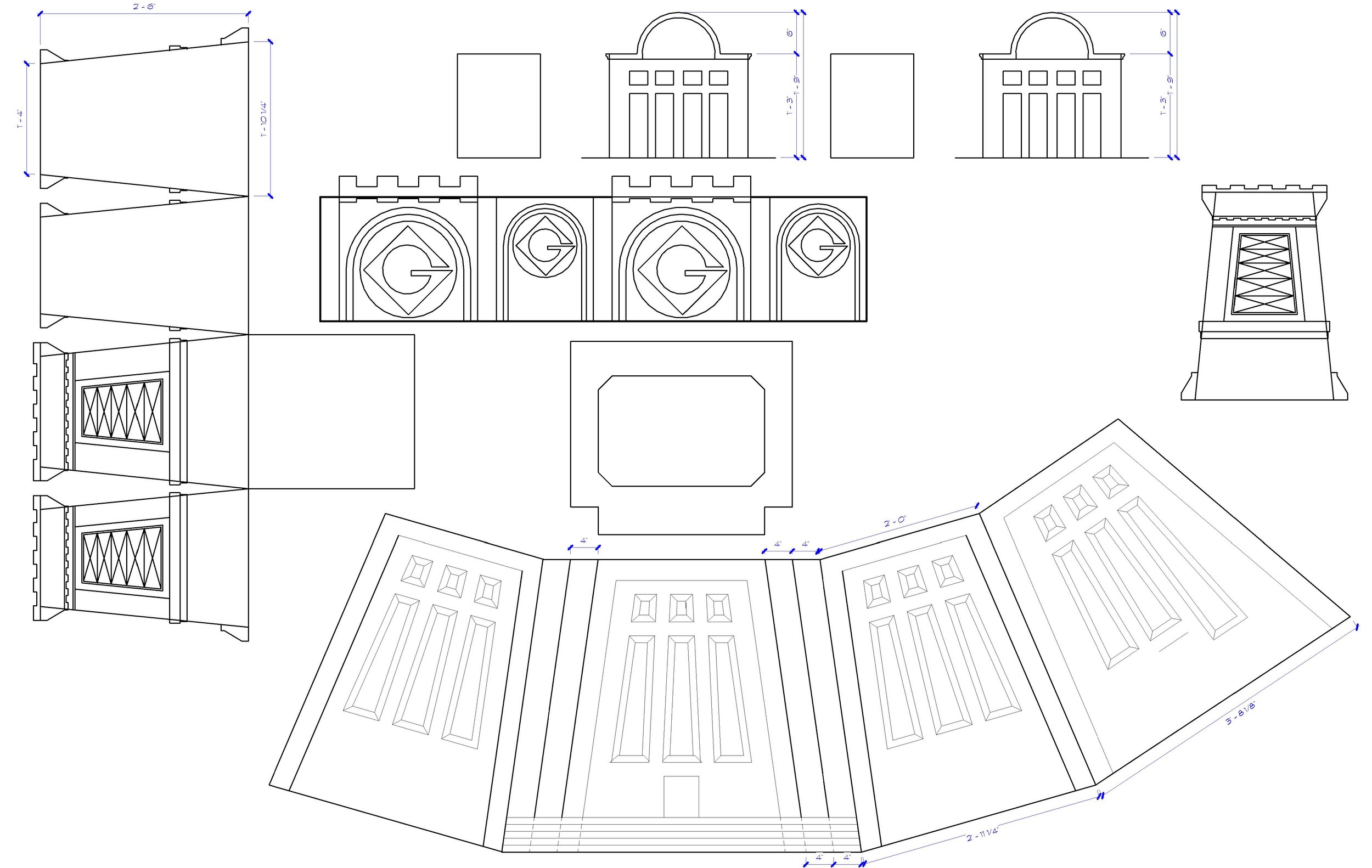
Recently, an unnamed boss handed me an unusual task – to craft components for a sand castle. While it may sound unconventional, this personal project never materialized beyond the initial request. However, what seemed like a whimsical endeavor turned into an unexpected opportunity for skill refinement.
The process involved identifying and creating repetitive forms that could be easily sculpted in the sand. What began as a playful exercise soon evolved into a unique design challenge. It highlighted the importance of embracing such opportunities, even when they involve requests for unpaid labor.
Design challenges come in various forms, from sand castles to intricate digital creations. They offer a chance to hone your skills, think outside the box, and discover innovative solutions. Here’s why you should consider taking on these challenges:
1. Skill Enhancement: Every design challenge, no matter how unconventional, presents a chance to sharpen your skills. Whether you’re a graphic designer, an architect, or a sculptor, each project forces you to think critically and refine your techniques.
2. Creative Thinking: Design challenges often push you to explore uncharted territories. They demand creative problem-solving and encourage you to experiment with new ideas. This innovation freedom can lead to groundbreaking concepts you can apply to future projects.
3. Adaptability: Design challenges rarely adhere to traditional guidelines. They require adaptability and the ability to work with limited resources or in unfamiliar environments. These skills can prove invaluable in real-world scenarios.
4. Portfolio Enrichment: Completed design challenges can be a valuable addition to your portfolio. They showcase your versatility and ability to tackle diverse projects. This can attract potential clients or employers interested in your range of skills.
5. Fun and Passion: Ultimately, engaging in design challenges should be enjoyable. It’s an opportunity to express your passion for creativity and design, regardless of the project’s scale or complexity.
The next time you’re presented with an unconventional design challenge, consider embracing it as an opportunity for growth. Use it to refine your skills, exercise your creativity, and demonstrate your adaptability. These challenges are not just about sand castles; they’re about sculpting your journey as a designer and artist.
Unlocking the Secrets of Genre Cinematic Conventions
In the world of cinema, understanding genre conventions is like deciphering a secret code that unlocks the essence of storytelling. In one of my film classes, I embarked on an intriguing assignment designed to deepen our comprehension of these conventions. The task was straightforward: choose a genre, craft an engaging narrative using a generic script, and orchestrate the shot design to convey the emotion and tone of the story within that genre. It was a challenge that opened the door to a realm of creativity.
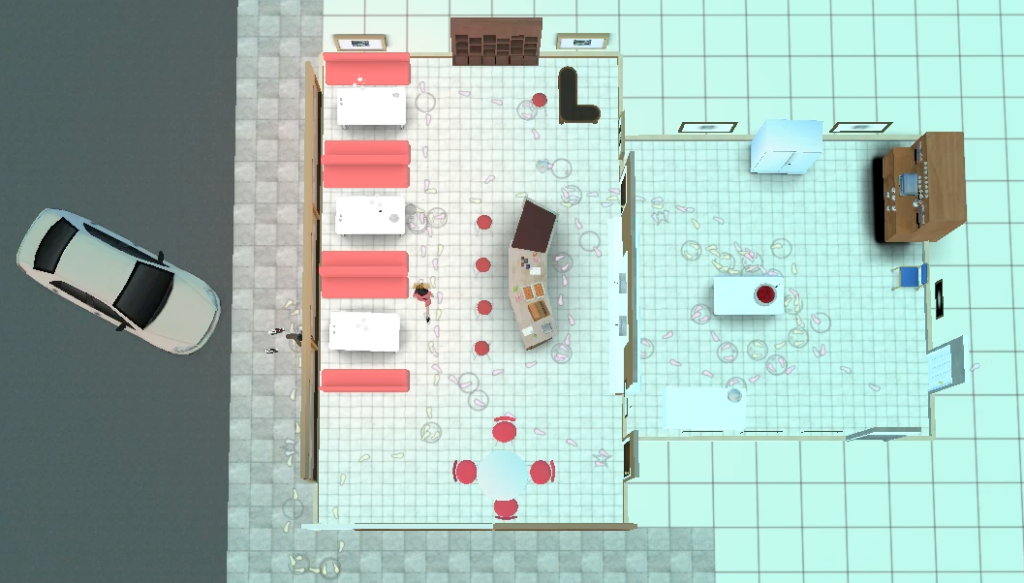
My chosen genre was suspense, a realm where uncertainty and anticipation reign. To bring my vision to life, I harnessed the power of a tool I had recently discovered – MovieStorm. This 3D animation software enabled me to translate my ideas into visual storytelling.
The provided script, a seemingly simple exchange of dialogue, served as the foundation for my suspenseful narrative. The challenge was to imbue each line with tension, to make every word count. It was a test of creative ingenuity and an exploration of the cinematic language of suspense.
The resulting video, linked above, captures the essence of suspense as characters navigate a cryptic conversation. The emotion is palpable, the tone is ominous, and the uncertainty is pervasive. It’s a testament to the power of visual storytelling and the impact of shot design on narrative atmosphere.
I invite you to delve into the suspenseful world I crafted and embark on your own cinematic adventures. Use the generic script as a canvas, paint it with your genre’s colors, and watch as it transforms into a unique narrative. Film is a boundless realm of creativity, and understanding genre conventions is the key to unlocking its full potential. So, have fun, experiment, and discover the secrets of cinematic storytelling for yourself.
Thought you all might get a kick out of reading a Contemporary Art term paper I wrote for visiting SCAD professor Karl Christoph Kluetsch. I enjoyed the freeing dialog of the class and also found the origin of my feminine imagery fixation.
Originally Published: March 8, 2009
THE STORY Literature and art have investigated and sometimes dramatized suicide in their commentaries on the human condition. Playwright William Shakespeare traversed the psychological motivations and even romanticized the act of suicide in his epic dramas. One of the most memorable examples surrounds the story of Ophelia. Written in 1601, Shakespeare’s Hamlet was the tragic tale of a Danish prince who tried to avenge his father’s death but ended up destroying everything he cared about. Ophelia was Hamlet’s love interest in the play. Distraught by the death of her father (Polonius), the increasingly erratic behavior of her love (Hamlet), and the absence of her brother (Laertes), Ophelia experienced a psychological break under the strain of events. The noblewoman reverts into crazed ramblings without the men in her life and eventually stumbles off to her death. Ophelia’s last moments are shrouded in mystery because we only hear the poetic announcement of the heroine’s watery demise from Hamlet’s mother, Queen Gertrude. This lack of documented theatrical action in Shakespeare’s play left visual artists a vast playground for interpretation. Long after Ophelia’s last curtain call, artists have revived her tale for new audiences to experience.
HISTORIOGRAPHY The implications of Ophelia’s story have been rehashed by numerous academics. Some view the character as a pathetic victim, while feminists like Gabrielle Dane profess that “Ophelia’s [suicide] choice might be seen as the only courageous—indeed rational—death in Shakespeare’s bloody drama” (Dane p 423). Dane tried to establish that, by taking her own life, Ophelia made a conscious choice not to live within the regimented confines of cultural roles. There are other studies which may lend validity to this claim. Nona Fienberg points out that Ophelia shows strength when she definitively labels Hamlet’s mental decline and when she insists on a meeting with Hamlet’s mother “to hold a mirror up to the court” (Fienberg p 136). In both instances, her speech patterns were decisive and on par with her male contemporaries. In addition, Leslie Dunn sees Ophelia’s musical ramblings before her death as, “literal and figurative dissonance” and points out that the dismissal of her words in the play speaks to society’s tendency to trivialize feminine identity and actions (Dunn p 59-60). These inclinations to create caricatures or stereotypes extend beyond the pages of the text. When the play is performed, directors take liberties of omission and physical exaggeration to paint Ophelia’s polar extremes. Susan Lamb examined 18th-century theatrical representations of the heroine and concluded that these highly sexualized depictions “in fact erase or obscure the place and influence of women in the public sphere. (Lamb p 106)“ These dichotomous representations have even led to speculative controversy accusing Claudius (Hamlet’s uncle) of impregnating and murdering Ophelia. So, this character as a feminine archetype has become a dynamic and complex path into gender identity. To delineate the impact of Ophelia’s stereotype, I plan to examine the visual expressions of these contradictory themes in contemporary art.
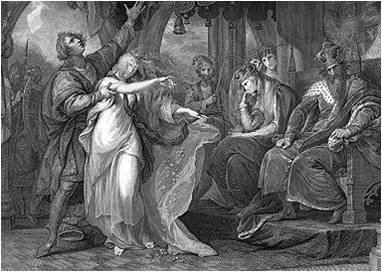
EARLY VISUALS Soon after Hamlet’s performance premiered, images of Ophelia started to appear. Eighteenth-century illustrations, usually associated with the printed manuscript, embraced the British stoic reserve. Ophelia was generally visible sitting or kneeling and devoid of any telling expressions. It was Benjamin West, an American painter of humble beginnings, who brought Ophelia’s emotional struggle to the front stage. West’s painting (fig. 04) showed Ophelia’s mid-wild, abandoned run.
Figure 04. Francis Legat. After the painting of 1792. Benjamin West Hamlet. 1802 Engraving.
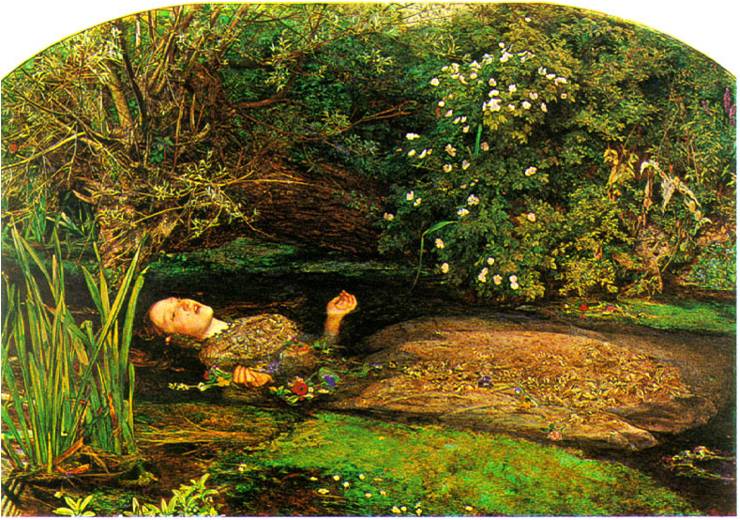
Her head was thrown sideways at an odd angle and her arms flayed out, barely hiding the debris in her tangled hair. Ophelia was shown barefoot and almost pregnant-looking in a gleaming white dress. West’s depiction opens the door for another artist to create what is arguably the most famous image of our heroine. Pre-Raphaelite painter John Everett Millais’s Ophelia (fig. 08) is praised with literally and figuratively plunging into Ophelia’s last moments.
Figure 08. John Everett Millais. Ophelia, 1852.Oil on canvas, 30 x 40 inches. The Tate Gallery, London.
A child prodigy from an affluent English family, Millais’s style was marked by intricate landscapes that seemed to give birth to or seek to encapsulate the floating lady completely. It was the first time that Ophelia was shown horizontally, and her upturned palms captured the hopeless surrender typically associated with her character. Later representations varied but elements used in West’s and Millais’s work are still used to evoke Ophelia’s spirit. In her book, The Myth and Madness of Ophelia, Carol Solomon Kiefer lists some of the visual cliches featuring Ophelia as “young and beautiful,” “frail,” having “consumptive-like pallor” with “long disheveled hair,” “flowing white dress,” “sometimes bare-breasted” and “often depicted at the side of or floating in a stream” (Solomon p 12). These elements string together to solidify a visual stereotype that can be recognized in numerous contemporary scenarios. However, they are ambiguous enough for interpretations to span countless themes and mediums. They weave a complex picture of what Ophelia has come to mean and the ways in which her image has been used in art over the centuries.
THESIS Ophelia walked the line between childhood innocence and a seductive woman. In the play, she dutifully tried to follow the moral and ethical codes of conduct established by her patriarch. Ophelia was supportive and conspired in the schemes concocted by her sibling. Her beauty fanned the carnal desires of an aspiring warrior, but her will held him at bay, which slipped her into the role of evil temptress. She was most at home in the gardens, surrounded by the creative and controlling force of Mother Nature. Like his contemporaries of the time, Shakespeare scribed this character to embody human frailty and the uniquely feminine divorce from logic and tendency towards witch-like, erratic behavior. However, mystery, intrigue, and even a little courage marked her rebellion against her assigned roles and yearning to explore her own independent, all be it terminal, path. Ophelia epitomizes child, mother, and temptress while managing to die a virginal princess, which catapulted her to the ultimate martyr and strikes a cord for discourse on human mortality. The ability to embrace all these contradictory modalities is one of the reasons Ophelia’s image has survived and is consistently replicated in modern art. To traverse the varying ways her essence has emerged, I have categorized the occurrences into four main groups that (1) speak to woman’s symbiotic relationship with nature, (2) mark the transition into womanhood and the death of innocence, (3) traverse and espouse female sexuality and identity, and (4) explore psychological reflectivity of Ophelia’s character. With that information, I hope to show how Ophelia’s representation in the visual arts relates to the original text and why her character is so often utilized as a creative muse.
WOMEN AND NATURE Unlike other deaths in Hamlet, Shakespeare sets Ophelia’s passing offstage. Kaara Peterson writes in Framing Ophelia: Representation and the Pictorial Tradition, “[Shakespeare] gives Gertrude this less than typical messenger performance (her only extended monologue in the play) and then provides for its immediate discrediting by the gravediggers. […] There is an epistemological gap in the text that cannot be filled in” (Peterson p 257). Without scriptural evidence, artists have taken symbolic clues from the rest of the play when assembling this scene. Because of the ambiguity, no one depiction can be right or wrong. The outcome is simply a matter of which clues the artist chose to focus on and in what order of importance. John Millais, for example, may have used Ophelia’s last dialog with the court for inspiration. In that scene, Ophelia goes around to the various characters, handing them plants with thematic meaning. In his “Study flowers in Ophelia’s garland to learn folk beliefs,” Shakespeare’s article for the San Francisco Chronicle, Rob Loughran, details how the rosemary Ophelia gave to her brother urged him to “remember” their father’s death and the rue she rationed to Hamlet’s mother and herself, was really calling for “repentance” for their mutual feminine sins. The specificity of such an act leaves us with the impression of Ophelia as the consummate gardener who is knowledgeable and respectful of nature’s powers and meanings. So when Hamlet’s mother describes Ophelia’s death, it is not surprising that it takes place in the garden, surrounded by “crow-flowers, nettles, daisies, and long purple” (Hamlet Act 4, Scene 7, Line 169). Shakespeare’s repeated references to plants in relation to Ophelia reinforce her connection to nature in the script. This motif has been depicted in numerous ways.
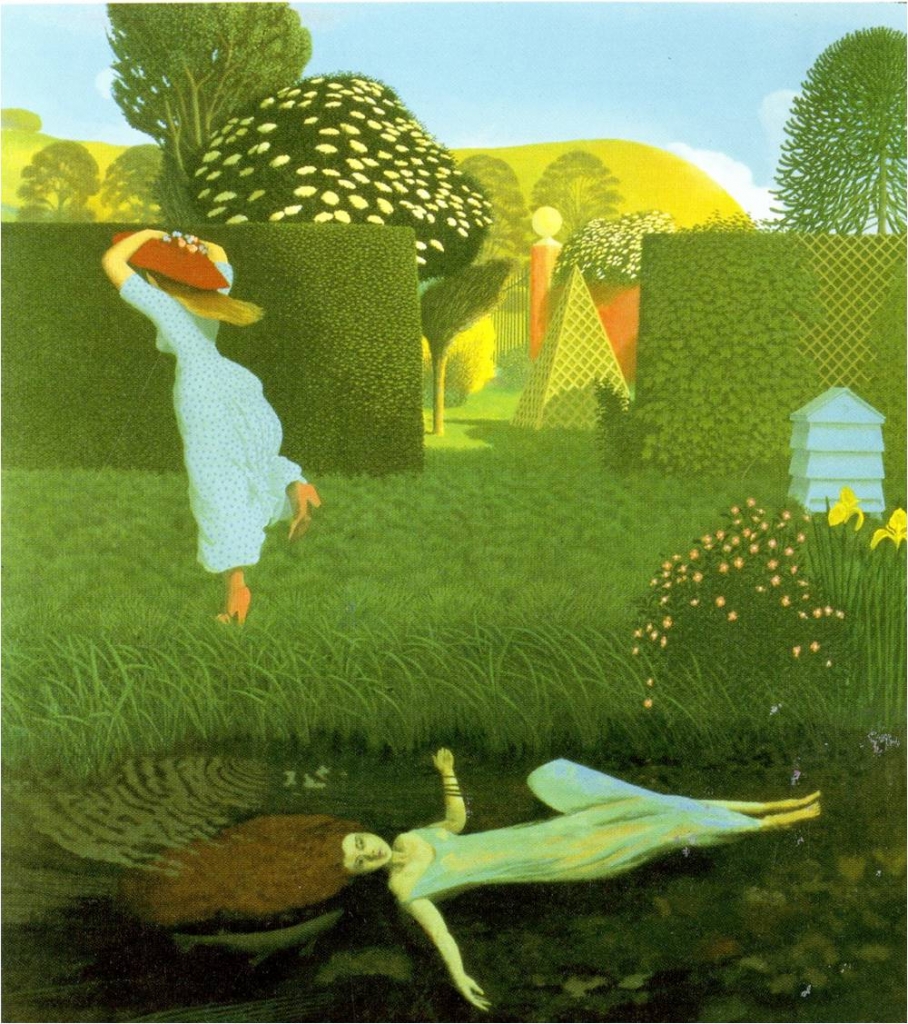
John Everett Millais set the artistic standard for associating Ophelia’s representation with nature, but what was important about his work was how immersed the subject was in its organic medium. Other artists have translated that quality into similar works. David Irnshaw’s The River Bank: Ophelia (fig 02) could be a snapshot of someone discovering the body.
Figure 02. David Irnshaw. The River Bank: Ophelia, 1980 oil on canvas.
We see very ordered, geometric, organic forms in the top half of the painting, which hints to the story’s domestic garden setting. A woman is shown running back towards the order, clutching tightly to the perfect symbol of decorum, her summer hat. Ophelia lays horizontal below with arms spread, positioned like a fallen crucifix. The monolithic organic masses seem to constrict Ophelia’s form. The lack of three-dimensional contouring and the use of heavily block colors give the “water” a murky quality of soil. So here, Ophelia is buried (locked in a grave) and consumed by nature. She is a part of the landscape and infinitely connected and defined by it.
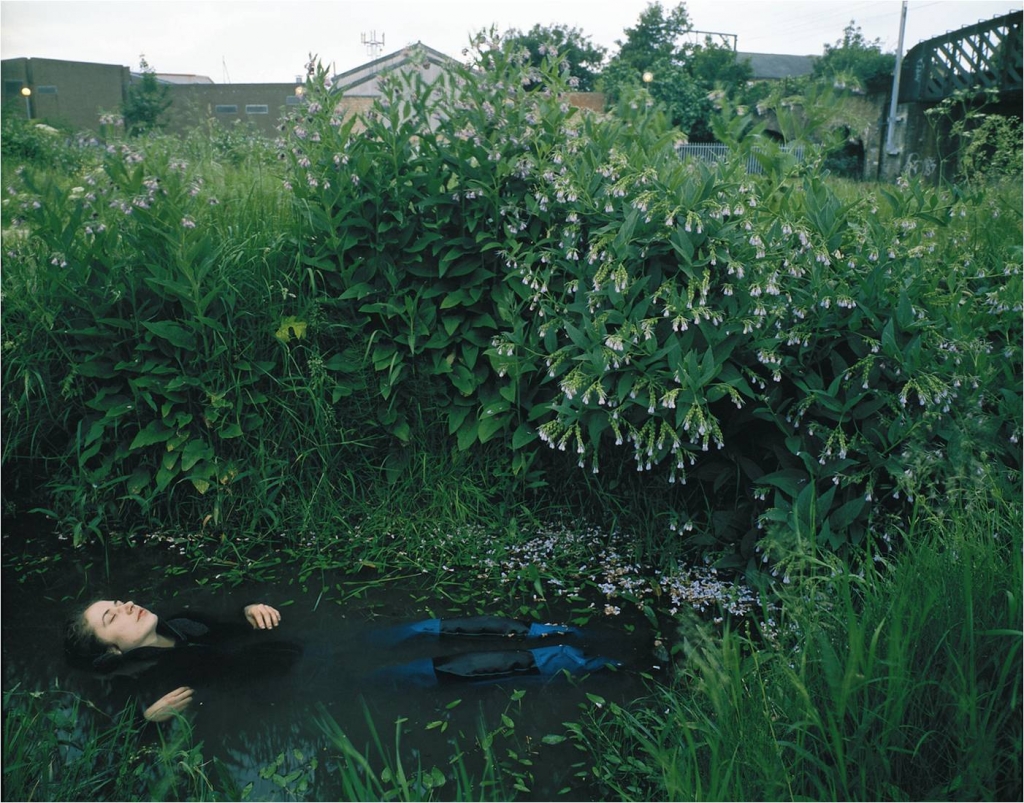
Although Irnshaw chose to stylize his painting to highlight Ophelia’s oneness with nature, there are also instances of more realistic replications. Charlotte Cotton calls this visual mimicry “reenactments” of popularized fables or myths in her book, The Photograph as Contemporary Art. She cites photographer Tom Hunter as an example of this technique, claiming, “[the] contemporary stimulus for The Way Home was the death of a young woman who had drowned on her way home from a party. The work shows this modern-day Ophelia succumbing to the water and metamorphosing into nature, an allegory that has had a potency for a visual artist for centuries” (Cotton p 55) (fig 01).
Figure 01. Tom Hunter. On the way home, 2000. C-print, 122 x 152cm
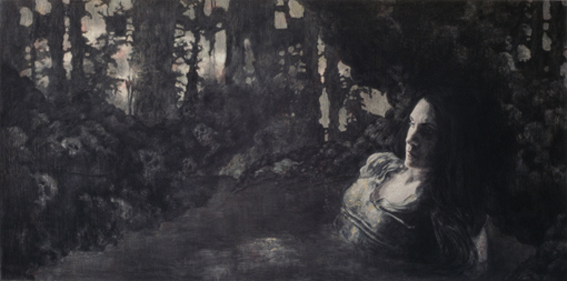
Hunter, who was born on the southern coast of England, works to try and find commonalities between the historical pictorial masterpieces and today’s popularized news events. In essence saying that history repeats itself, but in this case linking the occurrence to the girl’s possible drug-induced incapacitation. The young lady occupies less than a quarter of the page, as if at any moment the towering bush will crash down over her or the water will suck her down into the abyss. So like Millais, the proportional footprint of the woman to nature plays a key role. Iris van Dongen, used a similar distribution in her Ophelia by Night (fig 03).
Figure 03. Iris van Dongen, Ophelia by Night, 2004, pastel, charcoal, pencil, watercolor, acrylic on paper, 150×308 cm
The matron’s face and body remain primarily in a swelling shadow. Van Dongen, a mixed media artist who works in Berlin but hails from Holland, uses charcoal to literally blur the lines between what is nature and what is human. It is a self-portrait that returns woman, Ophelia in this case, to her roots. So all three artists evoked the sliding scale of proportionality and placement to show their subject’s inherent relationship to nature.
TRANSITION TO WOMANHOOD Ophelia’s family was determine to stay her quest into adulthood. The men in her life used possessive, object-oriented language towards her and repeatedly referred to her as naive. Before Laertes leaves for France he scolds Ophelia for being “a green girl” if she believes that such a highly ranked nobleman (Hamlet) could actually love her (Hamlet Act 1, Scene 3, Line 101). This talk is followed by numerous others saying that Ophelia was too young to know her own mind. She was seen as an innocent even though she was old enough to inspire Hamlet’s love letters, without any moral repercussions. So she was both woman and child and could be used as inspiration for a transitional exploration.
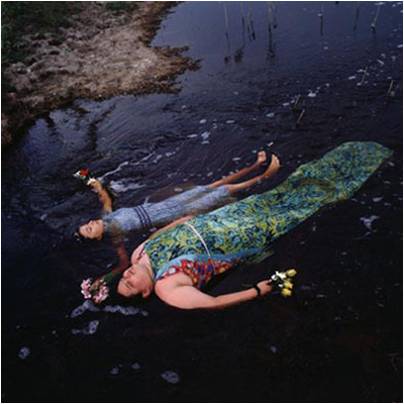
New York native, Alessandra Sanguinetti, has spent the last decade documenting the lives of two young Argentinean girls as they transition to adults. Sanguinetti works by having her subjects play-act their future fantasies or reenact scenarios based on artifacts brought back from her travels. For her series The Adventures of Guille and Belinda and the Enigmatic Meaning of Their Dreams, Sanguinetti brought back a postcard of Millais’s work and reflected,
“I expected [the girls] to be weary of getting dressed up and lying in cold water for the longish time I usually took to make a picture, but they were instantly attracted to it and wanted to act it out right away. I was glad they were enthusiastic, but at the same time I remember feeling a twinge of sadness and regret at their immediate identification with [Ophelia]” (Wildshut p 8).
The girls may have identified with Ophelia’s image because the idea of floating in water is a freeing experience that isolates you from the rest of the world. It gives you a sense of letting go of personal inhibitions.
Figure 10: Alessandra Sanguinetti, The Adventures of Guille and Belinda and the Enigmatic Meaning of Their Dreams: Ophelias, 2002
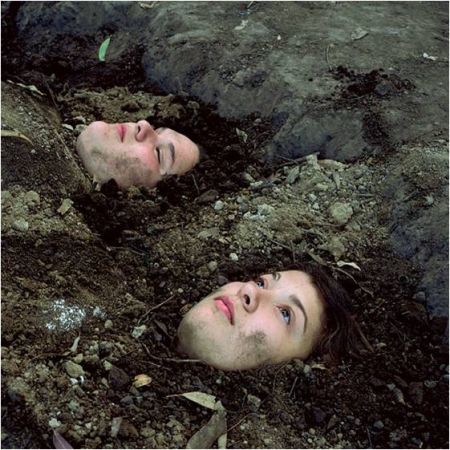
Like Hamlet’s character, these young women know that change is upon them and requires time and space for self-contemplation. Water’s transformative connotation is utilized, by Sanguinetti, to denote the next stages in life or the death of innocence. The artist starts this journey with Ophelias (fig 10) but furthers the motif in Times Flies (fig 12), where only the girls’ faces remain above ground.
Figure 12: Alessandra Sanguinetti, The Adventures of Guille and Belinda and the Enigmatic Meaning of Their Dreams: Time Flies (2005)
The book Ophelia: Sehnsucht, Melancholia, and the Desire for Death, reveals Flos Wildshut’s view about,
“[When] they are buried in the soil, with only their heads uncovered, the fantasy depicted becomes more morbid. In their childish dream world, in which a game is just a game, the outside world gradually seeps in. The girls grow more and more aware of their sexuality and the games they play with it are increasingly less innocent, on account of which we as spectator feel more and more like voyeurs.” (Wildshut p 88)
So, as these new Ophelias pursue life post-transformation or beyond their virginal, innocent predecessor, we, as the audience, are the ones left fighting to keep the pure image erect. In the play both Polonius and Laertes warn Ophelia of the dangers associated with a loss of innocence, urging her to protect it as her one useful treasure. To them, innocence and sensuality cannot occupy the same entity, or to gain sensuality is to lose innocence.
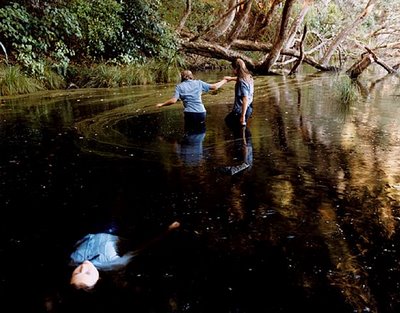
Figure 05. Justine Kurland, Another Girl, Another Planet: Eel Swamp, 1999 Satin finish UV laminated c-print, 30 x 40 inches.
Similar uneasy feelings are experienced when viewing Justine Kurland’s comment on New Zealand’s escalating suicide ratio and its transformative aspects in her photograph, Eel Swamp (fig 05). Kurland used children in school attire to, “break from the civilization that their uniforms suggest into a world of wilderness and abandon” and navigate the social topography of girlhood (Wildshut p 7). Much of the photograph peers onto water’s reflective surface so the viewer gets the impression that this carefree time is destined to end while constantly aware of how easily they could become victims like Ophelia. Even total submersion seems to bring about transformative issues. Desiree Dolron’s worked to physically test this theory in Gaze, Study Number 15 (fig 07).
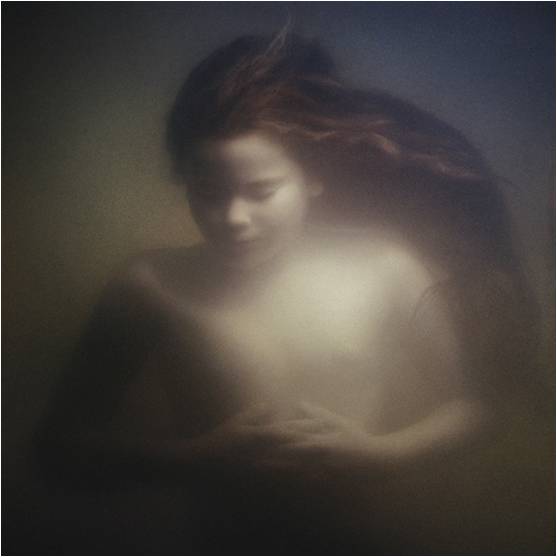
Figure 07. Desiree Dolron, Gaze, study number 15. 1996-1998. Cibachrome Print. 16”x20″
This Dutch photographer captured a uniquely disturbing scene while submerging her subject underwater. Isolated from outside stimuli for extended periods of time, these people often experienced transformative trances observed in Dolron’s earlier religious-based work, where she followed her subjects to their temples and other sacred locations. As eluded by Charlotte Cotton earlier, it is clear we are privy to something intensely private happening to this young girl. It leads us to question what Ophelia’s last moments entailed and if her “death” really marked a rebirth as a less fragmented woman.
FEMININE SEXUALITY AND IDENTITY Throughout the play, Ophelia struggles to mold herself to the desires of the men in her environment. When confronted with her family’s disapproval of Hamlet’s professed love, Ophelia’s only reply is, “I don’t know, my lord, what I should think” (Hamlet Act 1 Scene 3, Line 101). What is clear is everyone seems concerned with suppressing Ophelia’s sexuality, culminating with Hamlet’s rejection, “Get thee to a nunn’ry” (Hamlet. Act 3, Scene 1, Line 121). Hamlet, through lenses filled with the deceit perpetrated by his mother, links all sensuality to corruption. So, if you follow her family’s example, Ophelia is not allowed to think for herself and is now told by her love that she should suppress an essential part of her nature. Unfortunately, Ophelia is caught in a pattern of referential dependence. In the end, Ophelia’s identity is so tangled in relationships that their absence has disastrous results. Some modern artists chose to expose this repressed sensuality and, in conjunction, recapture the power of her feminine identity.
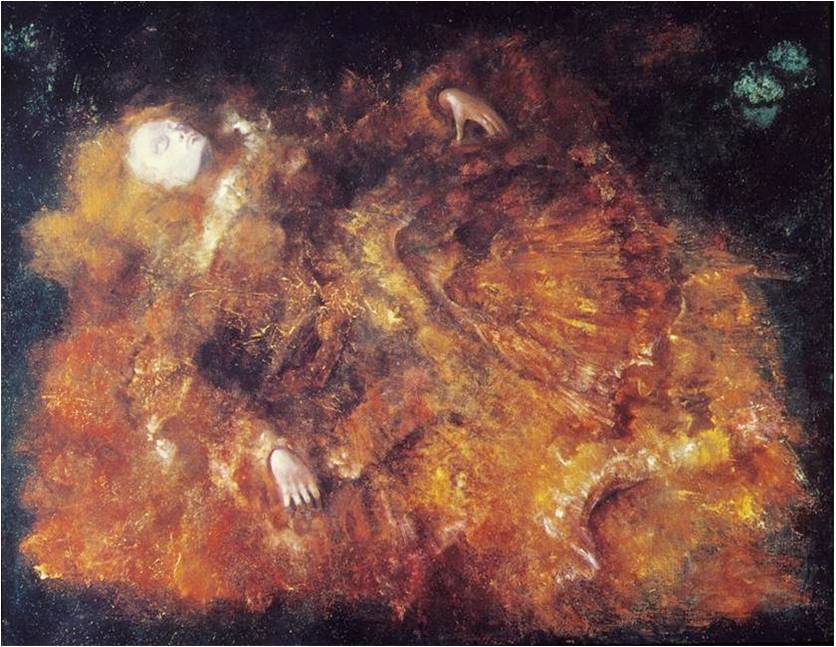
As an eccentric surrealist painter, Leonor Fini has a unique perspective on the fluidity of the feminine essence. All throughout her tumultuous childhood and transient adult life, she has literally assumed both male and female roles. This started under threats of kidnapping from her father, where Fini’s mother dressed her up as a little boy. Suppressing and switching between genders became a way of life. Consequently, Fini’s Ophelia (fig 09), blazes like the phoenixes featured in her other works.
Figure 09. Leonor Fini, Ophelia, 1938, oil on canvas.
The heroine dominates the canvas and boils the surrounding water as she spreads her sexuality. In The Art of Suicide, Ron M. Brown highlights the contrasting nature of Fini’s version. Although the key compositional elements are present, Brown sees this protagonist “as a muddled figure with a tortured expression on her face that flies in the face of the dream-like quality invested in [other] Ophelia imagery…[this] is a dirty death, and the dirt might symbolize her own entrapment in the plot” (Brown p 206). I tend to disagree with Brown’s assessment of the meaning behind Fini’s painting. The figure’s chin is proudly inclined and her arms are extended in a dancer-like pose. Her palms are down, not open skyward in a pleading gesture. This is not a damsel in distress but a powerful woman who seems to be rising again, as Ophelia: sensuality personified.
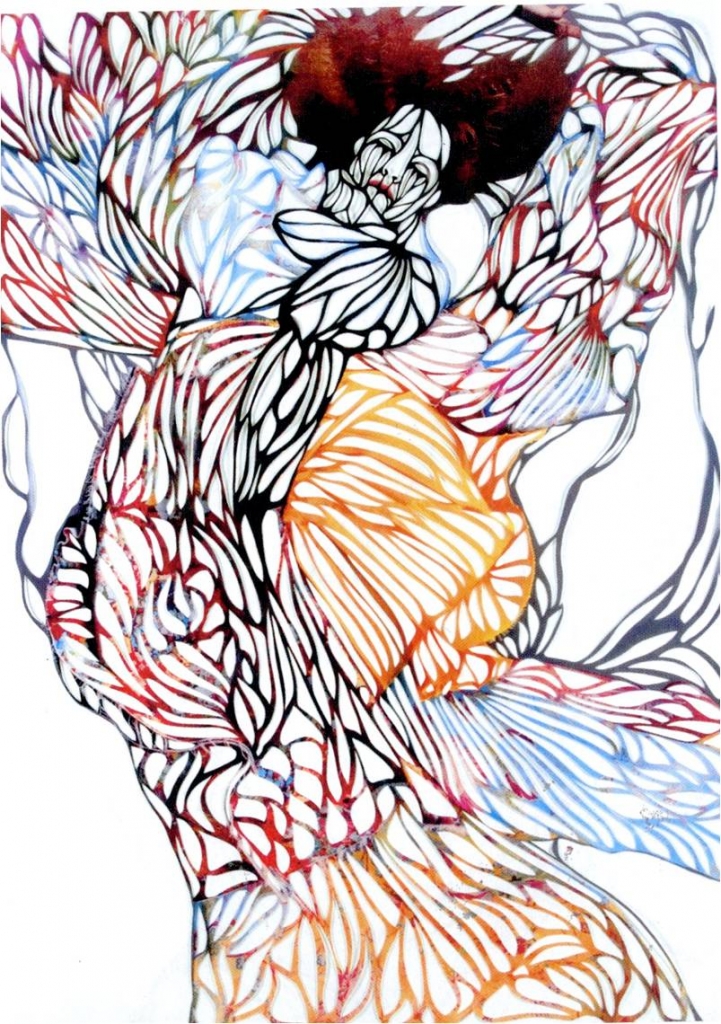
Figure 06. Amie Dicke, Whirlwind of Tempestuous fire, 2005. Cut out paper. 250 cm x 178 cm
Interesting comparisons can be drawn between Fini and the new mixed media work of Amie Dicke. The title, Whirlwind of tempestuous fire (fig 06), should indicate Dicke’s focus. This work features intertwining vines of color and form, which once were an editorial layout for a fashion magazine. Dicke uses these found images to meticulously extract sections, creating a web mosaic which she then overlays with layers of ink. Like FIni’s Ophelia, this character extends her tendrils over the piece with her hair fanned out around her. Art critic Ana Finel Honigma said this about the work as a preface to her 2007 interview with Dicke:
“Some critics have offered superficial connections between Dicke’s practice with her knife and cosmetic medical procedures, but the unmistakable morbidity of Dicke’s gothic glamour girls is not, as they mistakenly argue, a feminist criticism of fashion. Instead, her skinless sirens serve as proof that ‘eroticism is assenting to life, even up to the point of death,’ as stated by Georges Bataille. Dicke’s succubae remain confident and enchanting because they have been distilled down to their most essential erotic elements. Even without their skin, the girls beckon.”
In that same interview, Dicke talks about selecting images that have a decadent quality and dignified postures like upturned noses. Her women have lost their surface and hold on to life through Dicke’s pursuit of meaning behind their sensuality. Transforming those images of beauty into artifacts of decay forms direct links to Ophelia’s suspension in water. Dicke is trying to explore whether the fundamental essence of feminine sexuality is housed on the surface or emanates from the core spirit.
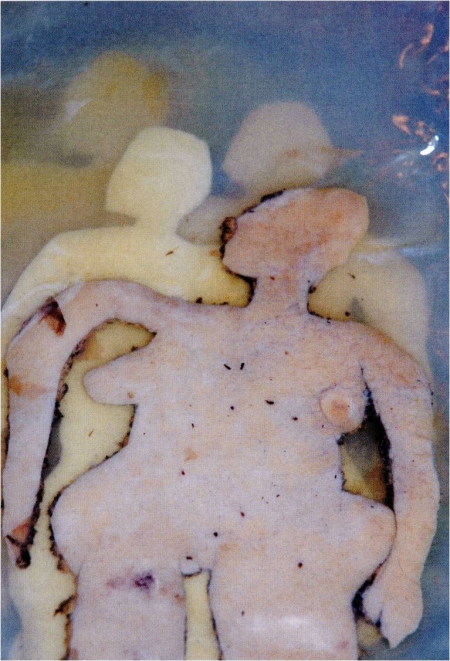
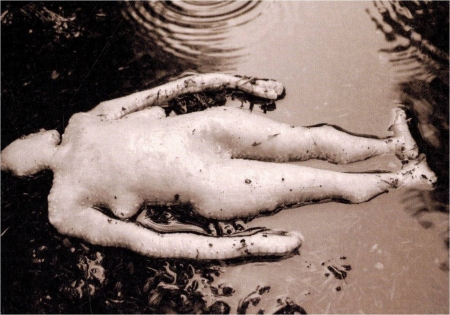
Other artists try to explore whether skin itself evokes the same quality of existence. Ironically, it was her own father’s tragic drowning that spurred Paola Ebanista’s fascination with skin. The Spanish artist uses large blocks of pigskin, which are either sown or woven together. In her photographs, Women (fig 14) and Ophelia in the Rain (fig 13), Ebanista constructs feminine figures and suspense them in formaldehyde. In her book Skin, author Heide Hatry explains the duality that exists once the skin is viewed separately from the body:
“Ebanista’s deformed, faceless drowned corpses (Ofelias) are symbols of bodies, ciphers of thee transitoriness of life, oscillating between abstraction and objectivity. Pale white, they stand in stark contrast to their environment; one moment they feel like foreign bodies, yet the next they seem completely absorbed into nature… It’s disturbing, shocking image that literally gets under one’s skin — because it confronts us with death in such and unusual way. (p 43)”
By “unusual,” Harty refers to the floating deaths featuring pale but beautiful Ophelias. In addition to these mock bodies, Ebanista also develops wearable second skins, which intensify the fetishistic nature of her work. Once the initial aversion subsides, questions about mortality and skin’s relationship to identity arise.
Figure 14. Paola Ebanista, Women. 2004. Photograph of pigskin and formaldehyde in plastic. 11x16in
Figure 13. Paola Ebanista, Ophelia in the rain, 2004. Photograph of pigskin. 20x28in.
This shed skin is an example of Abject art. According to Rosalind Krass in Informe without Conclusion, the emergence of “abjection” as an expressive mode was an insurgence rejection of previous artistic movements (Leung p395). It is an exploration of the tipping point between being held (suffocated) by precedence and expelling everything. Krass describes this losing battle for autonomy as, “the body’s own frontier, with freedom coming only delusively as the convulsive, retching evacuation of one’s own insides, and thus abjection of oneself” (Leung p 397). This graphic depiction can be taken literally and/or figuratively to indicate a fascination with the mid-range viscosity of slimy (oozing) bodily fluids or the shell that remains. The skin, our vessel, could be seen as the “leech-like past that will not release its grip…[and contains] its own form of possessiveness,” which the movement tries to explore, says Krass (Leung p 397). The possessiveness mentioned seems to take on a feminine quality even in Ebanista’s work. The idea of using the waste of people and things to create a symbolic link between the high [beauty] and lows [nothings] of life is a pervasive idea that runs rampant through abject theology. So, Ebanista’s work also serves to dissect the meaning of sensuality for which Ophelia is praised. The character is young and beautiful when she is taken by water, but Ebanista’s Ophelia shows that even in death, we would be drawn to her and possibly suffer from the guilt of perversion afterward. For Hamlet, Ophelia was “an object” to which he was both profoundly attracted and expressly repulsed. So, even in written form, this woman epitomized abjection.
PSYCHOLOGICAL MIRROR Shakespeare was known for creating reflective parallels in his work. Laertes’ loving relationship with his father allows you to question Hamlet’s loyalty to his patriarchal ghost and consequently understand Laertes’ immediacy for avenging action vs Hamlet’s hesitation throughout the play. Hamlet and Ophelia both suffer through psychological hardship but Hamlet works through his feelings in writing while Ophelia turns to songs that cannot be understood by her peers. Hamlet accuses the women in the play of “frailty” or haphazardly switching loyalties once their sexuality has been released. The Queen could be seen as guilty of this crime, but Ophelia’s loyalty only shifts because of Hamlet’s own actions. And finally, it is upon Ophelia’s death, literally at her gravesite, that Hamlet sees his indecisiveness for what it is and declares, “I loved Ophelia” (Hamlet Act 5, Scene 1, Line 269). Similarly, there are perceptible threads of psychological discourse in visual representations of Ophelia. When the work employs “actors” to tell the story, it seems to shift the focus away from the viewer inward to the emotional motivations of the characters depicted and the individuals who played the roles.
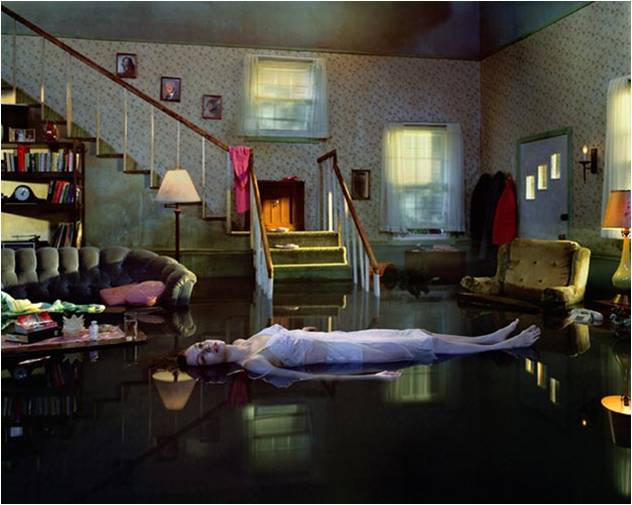
When we first encounter Gregory Crewdson’s Untitled (Ophelia) (fig 11), we stare into a downstairs living room with physical evidence of post-war suburban life scattered all around.
From the cascading family photos lining the stairwell and fuzzy, pink bed-slippers discarded mid-step, the winter jackets waiting on the coat rack by the door, or the well-read books and unfinished glass of water on the coffee table, all point back to a thriving family unit. These items lay undisturbed, as if the pool of water, below this threshold, crept in unsuspectingly. The inky black liquid threatens to slowly overtake the whole scene, carrying its first victim, a beautiful female corpse. Her eyes are open and facial expression is relaxed, contemplative, and even mildly angelic. The skirting light of daybreak washes over our victim, surrounding her in a halo of reflections on the water’s opaque, still surface. The fact that we can’t see what is below the surface is both figuratively and literally frustrating for the viewer. This woman died in a vulnerable, undressed state and the viewer is plagued with curiosity for the story behind, or underneath, the image. By transposing Ophelia’s tale inside a suburban structure, we are left without a natural disaster or accident to blame. This narrative was deliberate, so alone we must look inside the mind for the answer. During an interview with a literary scholar, Bradford Morrow, Crewdson explained that he was always interested in the “ambiguous narrative” that helped his audience question the psychological struggles behind his character’s strange actions (Crewdson p 17). So he is reenacting the popular fiction to examine his own fascination concerning what drives people, or in this case what would make a suburban Ophelia take her own life.
Crewdson’s fascination with psychological drivers started young when he would try to listen to his father’s therapy sessions with psychiatric patients through the floorboards of his house and then develop his own explanations for why they needed his father’s “help.” It was out of this curiosity that Crewdson’s work was forged. It seems ironic that the elaborate productions and surreal environments he creates are really an attempt to isolate or identify himself. Charlotte Cotton, from The Photography as Contemporary Art, classifies his narrative work as “tableau-vivant”: “[Crewdson] worked with a cast and crew of the kind found on a film set…it is not only the display of rituals and the paranormal but also the construction of archetypal characters that carry out these acts that create the psychological drama” (Cotton p 28).
The term tableau vivant translates from French as “living picture” and grew out of practices where whole theatrical sets were constructed and appropriately lit, only to have the actors “play” statues. Crewdson uses this technique to create surreal and vague moments in time. After the photo is taken, some minor digital manipulation is used to clean up the shot but the majority of Crewdson’s creative efforts occur before the aperture shuts. The result is a still life, which, from every angle, asks the viewer to identify what is wrong with this “perfect” picture of Ophelia’s contemporary life.
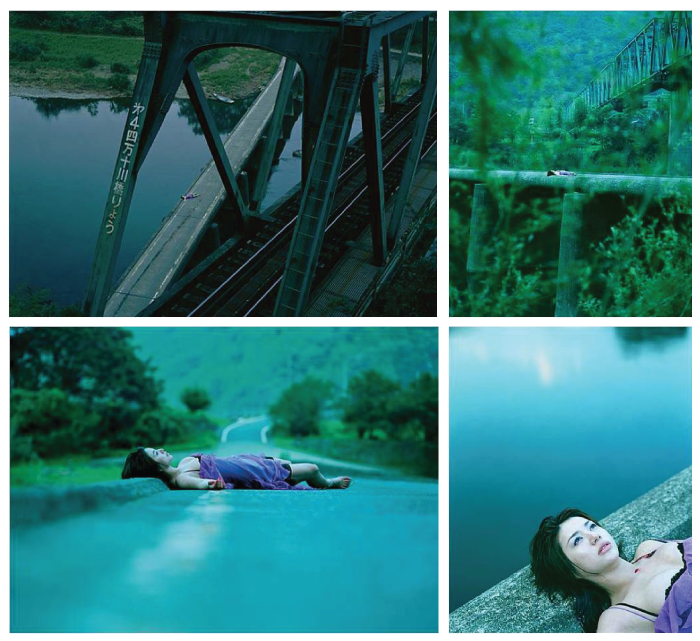
A similar ambiguous intent is used by Japanese photographer Izima Kaoru. Kaoru collaborates with models to construct their “perfect death,” complete with the appropriate designer attire. Flos Wildschut, in Ophelia: Sehnsucht, Melancholia, and Desire for Death, praises Kaoru’s work, saying, “the outright aesthetic quality ensures we [the viewer] keep death at bay. Its overwhelming beauty does not allow for comparison with our own death, which is why we can bear to stand the images and even admire them. (Wildschut p96)” Each model receives several frames, starting with an aerial shot (obscuring the model to a distant figure) and successively becoming more detailed until we stare right into the glassy eyes of the deceased. In Igawa Haruka, wearing Dolce Gabbana (fig 15), we see a railway bridge over calm waters, then shift to a horizon view down in the foliage looking over the rim of the embankment.
Next follows a groundhog perspective down the road from Haruka. The last two photos show the blood oozing from under her collar bone. The red color is in stark contrast with her pale skin and even more significant is the color control exhibited between the landscape and the subject. All pointing to the fact that Haruka’s injuries were not self-inflicted, this was not a suicide. That is until you consider that the models themselves have constructed these scenarios. They are willing participants in this project, instantly drawn, like Guille and Belinda, to the idea of acting out their own death. Although these tales do disparage the fashion industry, there is a bigger psychological impact on facing your mortality as adults. Being in that moment, having volunteered to die, these models embody everything Ophelia stands for, beauty, frailty, and a slight mental imbalance. Each death is specific to the model so, as actresses in a story of their making, they are forced to contemplate their motivations for selecting this particular demise.
CONCLUSION The story behind Ophelia remains a strong presence in contemporary art partially because the source text gives no definitive direction. This allowed an artist to utilize the entire play as a basis for their depictions. In Hamlet, Shakespeare constructed characters that composited multiple prevalent ideals which we, as the audience, are still trying to decipher today. For Ophelia, he layered contradicting models of innocence and sensuality, frailty and strength and a divide yet oneness with nature, to name a few. Her character traversed so many emotional states in the play that artist are both pulled and repelled by the implications surrounding her death. She is both an object and a person, from which psychological themes can be imprinted and/or extracted. This objectification idealized and trivialized her death into its current themes of aesthetic beauty. The canon of work that is Ophelia contains enough complexity to allow an artist to express their own cultural or emotional biases without corrupting the original essence expressed by Shakespeare. She motivates uninhibited explorations into mortality because her demise was unjust and universally pitied. Ophelia passes on the verge of adulthood and “out of her mind”, so she was a literal and figurative shell of herself. Into this abject vessel, artists are allowed to pore their own focused impressions, so Ophelia is the quintessential vacant muse.
WORKS CITED
Crewdson, Gregory. Dream of Life. Salamanca, Spain: Ediciones Universidad de Salamanca Ediciones, 1998.
Cotton, Charlotte. The Photograph as Contemporary Art. London: Thames & Hudson, 2004.
Krass, Rosalind. “Informe without Conclusion”, in Theory in Contemporary Art since 1985. Edited by Zoya Kocur and Simon Leung, 2004. p. 395-407.
Brown, Ron. The Art of Suicide. London: Reaktion Brooks, 2001.
Finel Honigman, Ana. “Amie Dicke Talks to Ana Finel Honigman”. Saatchi Galery Online. February 21, 2007. http://www.saatchi-gallery.co.uk/blogon/art_news/amie_dicke_talks_to_ana_finel_honigman/1567
Hatry, Heide, ed. Skin. 2006: Amalgamated Book Services.
Ophelia: Sehnsucht, Melanchola, Desire for Death. Amsterdam: Uitgeverij De Buitenkant, 2009
Solomon Kiefefer, Carol, ed. The myth and madness of Ophelia. 2001: Amherst, Mass. : Mead Art Museum, Amherst College.
Dunn, Leslie C. “Ophelia’s Song’s in Hamlet: Music, Madness, and the Feminine.” Embodied Voices: Representing Female Vocality in Western Culture. Ed. Leslie C. Dunn and Nancy A. Jones. New Perspectives in Music History and Criticism. Cambridge: Cambridge UP, 1994. 50-64.
Fienberg, Nona. “Jephthah’s Daughter: The Parts Ophelia Plays.” Old Testament Women in Western Literature. Ed. Raymond-Jean Frontain and Jan Wojcit. Conway: UCA, 1991. 128-143.
Lamb, Susan. “Applauding Shakespeare’s Ophelia in the Eighteenth Century: Sexual Desire, Politics, and the Good Woman.” Women as Sites of Culture: Women’s Roles in Cultural Formation From the Renaissance to the Twentieth Century. Ed. Susan Shifrin. Aldershot, Eng.: Ashgate, 2002. 105-123.
Loughran, Rob. “Study flowers in Ophelia’s garland to learn folk beliefs, Shakespeare.” San Francisco Chronicle. December 23, 2006. http://www.sfgate.com/cgi-bin/article.cgi?f=/c/a/2006/12/23/HOGVNN39851.DTL
“Can’t Stop the Flow”: A Glimpse into the Artistic Journey
The world of music videos often feels like a vivid dreamscape, a fusion of music, storytelling, and visual artistry. As the Art Director for Porschia’s gospel music video “Can’t Stop the Flow,” I had the privilege of contributing to this vibrant fusion of creativity.
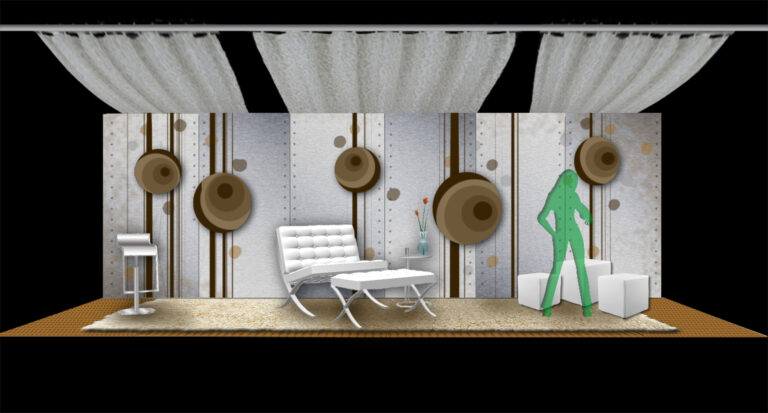
In this behind-the-scenes glimpse, we’ll explore the dynamic and versatile set designs that brought Porschia’s vision to life. From the conceptual drawings to the final music video, the project’s transformation is nothing short of mesmerizing.
https://youtu.be/hG9oBTFq4fQ?si=WVfczovsMa2ShX3U
Conceptualization and Collaboration
Our journey began with a concept – creating interchangeable sets and wardrobe concepts for a gospel singer. Porschia’s “Can’t Stop the Flow” needed to convey a powerful message and vibrant energy. The collaboration between Wilson Randall, Jr. (Director), Daniel Friedberg (Director of Photography), and myself as the Art Director was pivotal in bringing this vision to reality.
Streets, Warehouses, and Studios
The music video was a tapestry woven from diverse locations. The streets of Savannah, Georgia, provided an urban backdrop, capturing the raw and unfiltered essence of the song’s message. Warehouses lent a sense of grit and authenticity to the scenes, and studio spaces allowed us to play with imagination.
Dancing in a Warehouse, Singing on the Streets
One of the standout moments was capturing a little girl dancing in a warehouse. Her energy and enthusiasm brought a heartwarming touch to the video. Porschia herself, the gospel artist behind the project, sang her heart out on the streets, surrounded by a string of crystals that added a touch of mystique and elegance to the scene.
Futuristic Studio Set
The studio set was a marvel, where three futuristic versions of Porschia, singing in harmony, came together. It was an exciting challenge to create a visually captivating space that elevated the music’s message.
The “Can’t Stop the Flow” music video is a testament to the power of collaboration and the boundless possibilities of set design and scenic painting. It’s a reminder that every location, every prop, and every wardrobe choice plays a role in conveying the heart of a song.
As the Art Director, this project allowed me to blend my skills in scenic painting, set dressing, and art direction, weaving them into the visual tapestry that tells Porschia’s story. It’s a journey of creativity, imagination, and dedication, and I am grateful to have been a part of it.
Take a moment to explore the images of the concept art and the final music video project, and you’ll witness the transformation of an idea into a visual masterpiece, where art and music unite to create something truly remarkable.
Evolving Your Design Aesthetic: The Art of Continuous Growth
As a designer, your journey is one of constant transformation, and your design aesthetic evolves with every project you undertake. It’s a testament to your growth and a reflection of your commitment to refining your craft. Looking back on your early work, you might cringe a little, but it’s an essential part of the process. The experience of designing, creating, and learning is what shapes you into the designer you are today.
Consider the genesis of your creative journey, much like the first draft of a story that needs polishing. Your first projects may appear raw and unrefined compared to your current standards. You may wish you had approached your craft more seriously from the start. Such sentiments are common among creative individuals, as they recognize the untapped potential that lies within them.
However, it’s crucial to acknowledge that these early projects were pivotal stepping stones in your journey. They served as a foundation, laying the groundwork for your growth as a designer. These initial attempts were, in reality, experiments, and opportunities for learning. They allowed you to identify areas that needed improvement and to refine your creative skills.
From Cringe to Confidence
Now, fast forward to your present self. You can confidently affirm, “I have come a long way.” The evolution of your design aesthetic is a testament to your commitment, dedication, and eagerness to learn. Every project, regardless of its scale or complexity, has contributed to your creative journey and the development of your unique design sensibilities.
The advice you would extend to your younger self remains valuable – “don’t fall behind the clock.” The design world is ever-changing and dynamic, offering endless opportunities for exploration. Staying up-to-date with emerging trends and technologies is essential. Embrace learning and growing, and don’t shy away from challenges. It is through these challenges that you will continue to improve and evolve as a designer.
The Year of Resolution
Now, as you gaze into the horizon of 2020, view it as a year for resolutions and for sharing more of your work with the world. This year holds the promise of significant growth in your creative journey. Sharing your work and insights with a broader audience not only enhances your portfolio but also invites constructive feedback and the possibility of collaboration.
In 2020, challenge yourself to step out of your comfort zone. Push the boundaries of your creativity, experiment with new design concepts, and further refine your design aesthetic. Embrace every project as an opportunity for growth and learning. Please don’t shy away from bold ideas and challenging tasks, for it is the audacity that often leaves a lasting impact in the design world.
The Ongoing Journey
Your design aesthetic is a reflection of your experiences, inspirations, and your growth as a designer. It is like a canvas that continues to evolve, with each project adding a new brushstroke to the tapestry of your creative journey. The path you have traversed, from those early days to where you are now, is a testament to your unwavering dedication and passion for design.
As you continue your creative journey, remember there is always more to learn. This is the beauty of being a designer – building, refining, and expanding your skills as you take on new and diverse challenges. Embrace your growth, celebrate your progress, and anticipate the design aesthetic yet to unfold.
So, keep moving forward. Your journey as a designer is an ever-evolving masterpiece, a testament to your resilience and your commitment to the art of design.
Share Box
Blocksy: Share Box
Exploring the Art of Set Design in “Fahrenheit 451”
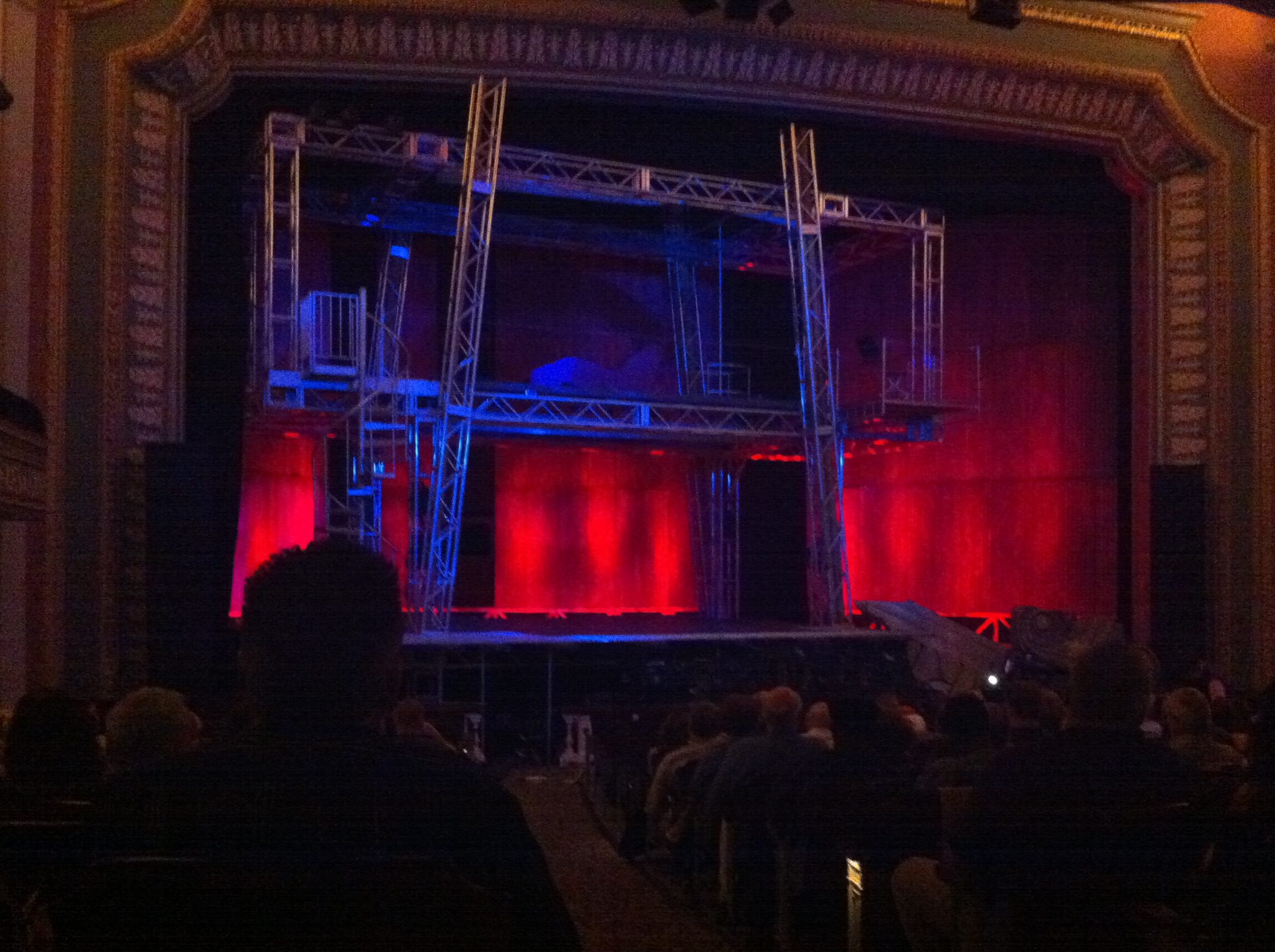
Set design is an often-overlooked aspect of the theater, but it plays a crucial role in creating the world in which a story unfolds. Working as an assistant to production designer Hal Tine during pre-production photography for the stage play “Fahrenheit 451” was a remarkable journey into the realm of creative expression and storytelling.
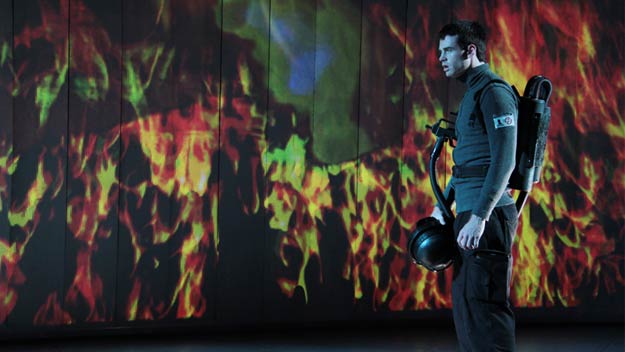
The show, which had its grand premiere at SCAD’s Lucas Theater, captivated audiences with its thought-provoking narrative and visually stunning set. What makes this production particularly intriguing is how the footage captured during pre-production photography was seamlessly integrated into the live performance.
The meticulous work of production designers is a testament to the power of visual storytelling. Hal Tine’s exceptional talent and artistic vision came to life in the set design for “Fahrenheit 451.” The stage was transformed into a captivating world that perfectly mirrored the dystopian universe depicted in Ray Bradbury’s classic novel.
The incorporation of pre-production photography in the play was a brilliant stroke of creativity. It allowed for the seamless integration of visuals that transported the audience into the heart of the narrative. The images served as windows into the characters’ emotions and the story’s essence.
As an assistant, I witnessed firsthand how every detail was meticulously planned and executed to create a powerful visual experience. It was an opportunity to appreciate the collaborative effort of the entire production team, where each member played a vital role in bringing the vision to life.
The success of “Fahrenheit 451” is not just a testament to the late Hal Tine’s extraordinary design skills but also to the profound impact that visual storytelling can have in the world of theater. It underscores the idea that a well-crafted set is more than just a backdrop; it’s a character in its own right, influencing the narrative and enhancing the audience’s emotional connection to the story.
In the world of theater, set design is a magical art form that deserves recognition for its ability to transform words on a page into a living, breathing world. “Fahrenheit 451” is a shining example of how this art form can elevate a production, leaving a lasting impression on all who experience it.